
6 Must-Know Features of Modern Price Trackers
Trying to unlock the best deals often means spending hours hopping between sites, comparing prices, and second-guessing your timing. You want to save money but keeping track of every price drop, sale, and retailer can quickly become overwhelming. It’s easy to miss out on genuine discounts or waste time chasing offers that aren’t what they seem.
This guide gives you practical tools to take control of your shopping experience with confidence. You’ll discover features that help you catch deals in real time, track historical price trends, and make smarter decisions with less effort.
Get ready to explore the specific ways you can use automated monitoring, real-time alerts, centralized dashboards, and more to outsmart unpredictable prices. Each tip gives you an advantage for smarter spending—so you never have to wonder if you’re really getting the best deal.
Table of Contents
- 1. Automatic Daily Price Monitoring For Accurate Updates
- 2. Real-Time Price Drop Alerts To Catch Deals Instantly
- 3. Detailed Price History Charts For Smart Decisions
- 4. Centralized Dashboard To Track Multiple Items Easily
- 5. Wide Store Coverage For Maximum Savings Opportunities
- 6. No Extension Needed For Simple Price Tracking
Quick Summary
| Key Insight | Explanation |
|---|---|
| 1. Set Up Automatic Price Monitoring | Automatically track prices daily to never miss changes and gain insights on trends. |
| 2. Utilize Real-Time Price Drop Alerts | Receive instant notifications for price drops, giving you a better chance at securing deals. |
| 3. Analyze Detailed Price History Charts | Use historical data to understand pricing trends and make informed purchasing decisions. |
| 4. Centralize Your Tracking with a Dashboard | View all tracked items in one location to simplify comparisons and save time. |
| 5. Ensure Wide Store Coverage for Savings | Track prices across multiple retailers to discover the best deals and avoid overpaying. |
1. Automatic Daily Price Monitoring for Accurate Updates
Manually checking prices across multiple retailers is exhausting. Automatic daily price monitoring removes this burden by tracking product prices 24/7 without any effort from you.
Here’s what happens when you set up automatic monitoring: the system checks your tracked items every single day and records each price change. This creates a complete historical record of how prices fluctuate over time.
Why does daily monitoring matter for your wallet?
- You never miss a price drop - alerts notify you immediately when prices fall
- You see the full picture - historical data shows whether today’s price is actually a good deal
- You understand patterns - daily tracking reveals when products typically go on sale
- You make confident decisions - no more wondering “should I buy now or wait?”
Let’s say you’ve been eyeing a laptop priced at $899. Without tracking, you might buy it next week only to discover it dropped to $749 two days later. With automated price monitoring, you’d see that exact price movement and catch the deal.
The real power comes from understanding pricing trends. When you have 30 days of daily price history, you can spot the seasonal patterns. Electronics often dip after product launches. Seasonal items go on sale when that season ends.
Daily price monitoring transforms you from a passive shopper into a strategic buyer who understands market behavior and timing.
Here’s what real-time price tracking with AI-powered systems accomplishes: it continuously monitors competitor prices across multiple retailers, records every change, and enables you to analyze pricing trends without doing any manual work yourself.
The convenience factor alone changes everything. Instead of opening five tabs and comparing prices manually, your tracker does this automatically. Every morning, you can check your dashboard and see exactly what changed overnight.
Budget-conscious shoppers benefit most from this feature. You’re not just saving money on individual purchases; you’re building a shopping strategy based on real data.
Pro tip: Set up monitoring for items you plan to buy within the next 1-3 months, not just things you want right now; this gives you enough data to spot genuine deals versus temporary price spikes.
2. Real-Time Price Drop Alerts to Catch Deals Instantly
Imagine being notified the exact moment a product you want drops in price. Real-time price drop alerts make this happen by sending instant notifications whenever prices change on your tracked items.
This feature works like having a personal shopping assistant who watches prices around the clock and taps you on the shoulder when something good happens.
Why instant alerts matter for deal hunting:
- Speed advantage - you catch deals before they sell out
- Less competition - fewer shoppers know about price drops at the exact moment they occur
- Reduced regret - you never miss a sale you would have wanted
- Peace of mind - you can stop manually checking prices yourself
Here’s the reality of online shopping without alerts. A popular item drops from $150 to $89 for just 12 hours. By the time you think to check the price manually, those 12 hours have passed and the price is back up. You miss the deal completely.
With real-time price drop alerts, you get notified the moment that $89 price appears. You have a genuine window to act before the deal disappears.
The difference between catching a deal and missing it often comes down to seconds, not days.
How do these alerts actually work? Once you set a price alert, the system monitors that product continuously. The moment the price drops below your target, a notification gets sent to you via email or app notification. This happens in real time, not hours later.
Consider a practical example. You want a wireless headset but won’t pay more than $60. You set an alert. Three days later, the price drops to $57.99 during a flash sale. You’re notified instantly and can purchase before the price bounces back.
Multiple retailers complicate this further. The same headset might be $65 on Amazon, $59 on Walmart, and $62 on Best Buy. Without alerts, tracking all three prices manually becomes tedious. Alerts handle this automatically across all retailers.
What makes alerts particularly powerful for budget shoppers:
- You can set multiple alerts on the same item across different stores
- You control the price threshold that triggers notifications
- You won’t be bothered by small fluctuations, only meaningful drops
- You maintain full control over notification frequency
The psychology of shopping changes with alerts too. Instead of feeling rushed to buy now, you can wait confidently knowing you’ll be notified if prices improve.
Pro tip: Set your alert price at 15-20% below the current price rather than waiting for the absolute lowest point; this catches genuinely good deals while avoiding the trap of waiting indefinitely for a price that may never drop further.
3. Detailed Price History Charts for Smart Decisions
A price chart is more than just pretty lines and numbers. It’s your window into how much a product actually costs over time and when the best buying windows occur.
Price history charts visualize every price change a product has experienced, often spanning weeks, months, or even years. This historical data becomes your competitive advantage when making purchasing decisions.
Why charts matter more than single prices:
- Context matters - today’s price only makes sense compared to past prices
- Patterns emerge - you discover when products reliably go on sale
- Confidence builds - you know if you’re getting a genuine deal
- Timing improves - you learn when to wait and when to buy
Here’s a real scenario. You’re looking at a tablet listed at $299. The price seems reasonable, right? But the chart reveals that this same tablet cost $229 just two weeks ago and regularly drops to $249 in the afternoons. That $299 price isn’t a deal at all.
Without charts, you’re essentially shopping blind. You can’t distinguish between normal prices and actual bargains. Understanding price behavior through detailed charts helps you make informed decisions based on data rather than guesswork.
Charts transform impulse buying into strategic purchasing by showing you the complete pricing picture.
How do these charts help you specifically? Price intelligence from historical data enables you to identify trends, seasonal variations, and market dynamics that affect pricing. You see which months offer the best prices and which represent peak pricing seasons.
Consider clothing shopping. Charts show that winter coats drop dramatically in March when spring arrives. Back-to-school supplies plummet after Labor Day. Holiday items get marked down in January. These aren’t guesses; they’re patterns visible in the data.
Electronics follow similar patterns. New product launches often trigger sales on older models. Major shopping events like Prime Day or Black Friday create predictable dips. Knowing these patterns lets you time your purchases perfectly.
What your charts should reveal:
- Current price versus lowest recorded price
- Lowest and highest prices over specific timeframes
- How often prices change (volatile versus stable)
- Seasonal trends and recurring sale patterns
- Price comparison across different retailers
Some shoppers see a chart and think “I’ll wait for the lowest price ever.” That’s dangerous thinking. If a product usually ranges from $80 to $120, and you see it at $85, that’s a genuine deal even if it hit $79 once eight months ago.
Pro tip: Look for the price that appears most frequently on the chart rather than the absolute lowest point; that “normal low” price is far more likely to occur again than a one-time anomaly.
4. Centralized Dashboard to Track Multiple Items Easily
Tracking dozens of products across multiple websites is exhausting when you’re jumping between browser tabs and bookmarks. A centralized dashboard consolidates everything into one place so you can monitor your entire watchlist at a glance.
Instead of checking Amazon, then Walmart, then Best Buy separately, your dashboard shows all tracked items and their current prices on a single screen.
Why consolidation saves you time and money:
- One screen, complete overview - see all your tracked items instantly
- Less time wasted - no more searching through multiple tabs
- Better decision-making - compare prices across retailers without switching views
- Organized tracking - manage hundreds of items without confusion
Imagine you’re tracking a laptop, three sets of headphones, two gaming monitors, and a keyboard. Without a dashboard, you’d have eight different browser tabs or bookmarks to manage. One tab per item, scattered across your browser.
With a unified dashboard, all eight items appear in rows on a single screen. You see each item’s current price, lowest recorded price, and price change percentage immediately. Centralized dashboards enhance real-time monitoring by presenting key indicators like current status and trends in one visual interface.
A dashboard transforms price tracking from overwhelming to manageable.
The real power emerges when you’re comparing similar products. You want to choose between three monitor models to maximize your budget. Without a dashboard, you’d need to review three separate price history charts. With a dashboard, you see all three listed with their current prices, lowest prices, and trends side by side.
This comparison ability matters significantly for budget shoppers. You might discover that Monitor B is actually cheaper than Monitor A when you see them together. That discovery only happens when all options are visible simultaneously.
Dashboards also handle status tracking naturally. You can see which items are on sale today, which have recent price drops, and which are stable. Some items might show a green indicator for “good deal” and others show orange for “wait for better price.”
What an effective dashboard shows:
- Current price for each tracked item
- Lowest price ever recorded
- Price trend over time (up, down, or stable)
- Last price check timestamp
- Alerts or notifications for price drops
- Option to add items quickly
- Ability to organize items by category or priority
Organization becomes your competitive advantage. Group items by shopping goal: electronics, clothing, home goods. Or organize by urgency: “need this week,” “buying next month,” “wish list.”
Pro tip: Organize your tracked items into folders or categories by purchase timeline; this prevents decision fatigue and helps you focus on items you actually plan to buy soon rather than scrolling through a list of vague wish-list items.
5. Wide Store Coverage for Maximum Savings Opportunities
Not all retailers offer the same prices. A product might be $50 on Amazon, $45 on Walmart, and $42 on Best Buy. If your price tracker only monitors one store, you’re missing savings you don’t even know exist.
Wide store coverage means your tracker monitors prices across dozens or even hundreds of retailers simultaneously. This breadth of coverage is what separates good trackers from great ones.
Why store coverage directly impacts your savings:
- More options visible - you see every retailer’s price, not just a few
- No hidden deals - smaller retailers often have better prices than big names
- Competitive pricing revealed - you understand the true market price
- Shipping differences matter - some retailers offer free shipping that others don’t
Here’s a realistic example. You’re shopping for a coffee maker. Major price trackers show it’s $129 on Amazon and $125 on Walmart. You pick Walmart. But a tracker with wider coverage reveals a smaller specialty kitchen retailer is selling it for $89 with free shipping. That’s a $40 difference you would have missed.
Maximizing savings opportunities requires coverage across wide geographic and digital store networks, including online marketplaces, specialty retailers, and international options that mainstream trackers often overlook.
Store coverage determines your savings ceiling. Limited coverage means leaving money on the table.
Different stores specialize in different product categories. Best Buy excels with electronics. Target dominates household goods. Specialty retailers lead in their niches. A comprehensive tracker monitors all of these simultaneously instead of forcing you to check them manually.
Consider the logistics advantage. Some retailers offer free shipping on orders over $25. Others have same-day delivery in certain areas. Others include extended warranties automatically. These variables affect your true cost, but you only discover them when comparing across stores.
What wide coverage enables you to find:
- Stores with free shipping thresholds you already meet
- Retailers offering extended warranties or return policies
- Marketplace sellers undercutting major retailers
- Regional stores with better pricing on local products
- International retailers with competitive pricing
- Flash sale retailers with limited-time deep discounts
The omnichannel retail landscape complicates pricing. A brand might sell directly through its own website, through Amazon, through Walmart, and through specialty retailers simultaneously. Each channel uses different pricing strategies. Tracking prices across multiple retail channels ensures you catch deals wherever they appear.
Budget shoppers especially benefit from broad coverage. You’re already hunting for deals. Limiting yourself to two or three retailers means accepting deals that aren’t actually the best available. Wide coverage transforms good deals into exceptional ones.
Pro tip: When comparing stores, factor in total cost including shipping, taxes, and return policies, not just the listed price; sometimes a higher sticker price at one retailer becomes cheaper when you account for free shipping that competitors don’t offer.
6. No Extension Needed for Simple Price Tracking
Browser extensions sound helpful until you realize they slow down your computer, clutter your toolbar, and require constant updates. Modern price trackers eliminate this friction by offering web-based solutions that work without installing anything.
You simply log in to a website or app and start tracking prices immediately. No downloads. No installations. No permissions to grant. Just straightforward price monitoring.
Why extension-free tracking matters for everyday shoppers:
- Faster browsing - no extensions slowing down your browser
- Cleaner interface - your toolbar stays organized and uncluttered
- Works everywhere - access your tracker from any device, phone, or computer
- Easier setup - start tracking prices in seconds, not minutes
- No maintenance - no extension updates to manage
Think about your current browser. If you’re like most people, you have five to ten extensions installed. Each one consumes memory and processing power. Each one adds icons to your toolbar. Each one requires periodic updates that sometimes break functionality.
Adding another extension becomes annoying. Modern price tracking solutions increasingly offer web-based dashboards that eliminate the need for browser extensions entirely, allowing you to monitor prices through cloud platforms accessible from any device.
Extension-free tracking respects your browser and your device.
Web-based trackers work like any other website you visit. You open your browser, navigate to the tracker’s site, and you’re ready to track prices. No technical knowledge required. No system permissions to worry about.
The accessibility advantage matters significantly. Your desktop computer, laptop, phone, and tablet can all access the same tracker through a web browser. You see consistent information across all your devices without syncing issues.
Consider the real-world benefit. You’re at the store and want to check if an item is cheaper online. Pull out your phone, open your price tracker in your browser, and instantly see pricing from all retailers. No extension needed on mobile devices. No app required if you don’t want one.
What web-based trackers offer:
- Log in from any internet-connected device
- Automatic cloud backup of your tracked items
- Instant notifications sent to email or phone
- Real-time price updates without lag
- No version compatibility issues
- Simplified setup process
- Cross-device synchronization
Security also improves with web-based solutions. Browser extensions require access to your browsing data and can theoretically track your activity. Web-based trackers follow standard internet security protocols without needing invasive permissions.
The simplicity factor appeals to everyone. You don’t need to understand how extensions work or troubleshoot installation problems. You just want to track prices and save money. A straightforward website accomplishes that without unnecessary complexity.
Pro tip: Bookmark your price tracker’s website in your browser so you can access it with one click; this makes price checking as fast as opening any other website you visit regularly.
Below is a comprehensive table summarizing the key advantages, features, and practical applications of the price tracking and monitoring strategies discussed in the article.
| Feature | Description | Benefits |
|---|---|---|
| Automatic Daily Price Monitoring | Systems track prices 24/7, maintaining a historical record of price changes. | Buyers can identify genuine deals, understand trends, and make confident purchasing decisions. |
| Real-Time Price Drop Alerts | Notifications alert users instantly of price drops on tracked products. | Shoppers take advantage of deals promptly and mitigate missed opportunities. |
| Detailed Price History Charts | Historical visual pricing data portrays fluctuations over time. | Enables pattern identification and strategic purchase timing. |
| Centralized Dashboard | Compiles all tracked items and their data in one interface. | Provides convenience and a comprehensive view for decision-making and comparison. |
| Wide Store Coverage | Monitors multiple retailers for comprehensive price comparison. | Ensures users access the best offers from various sources. |
| No Extension Required | Web-based systems eliminate the need for browser extensions. | Simplifies usage and enhances cross-device compatibility. |
Take Control of Your Shopping with PriceLix’s Powerful Price Tracking Features
The challenge of manually monitoring multiple retailers, missing sudden price drops, and guessing the right time to buy is frustrating and costly. This article highlights critical pain points like the need for automatic daily price monitoring, real-time price drop alerts, and detailed price history charts to make smarter purchasing decisions. PriceLix tackles these exact problems by offering a user-friendly platform that tracks prices across thousands of stores including Amazon, Walmart, and eBay while delivering instant notifications so you never miss a deal. With a centralized dashboard and no need for browser extensions, PriceLix transforms overwhelming price tracking into a seamless, empowering experience.
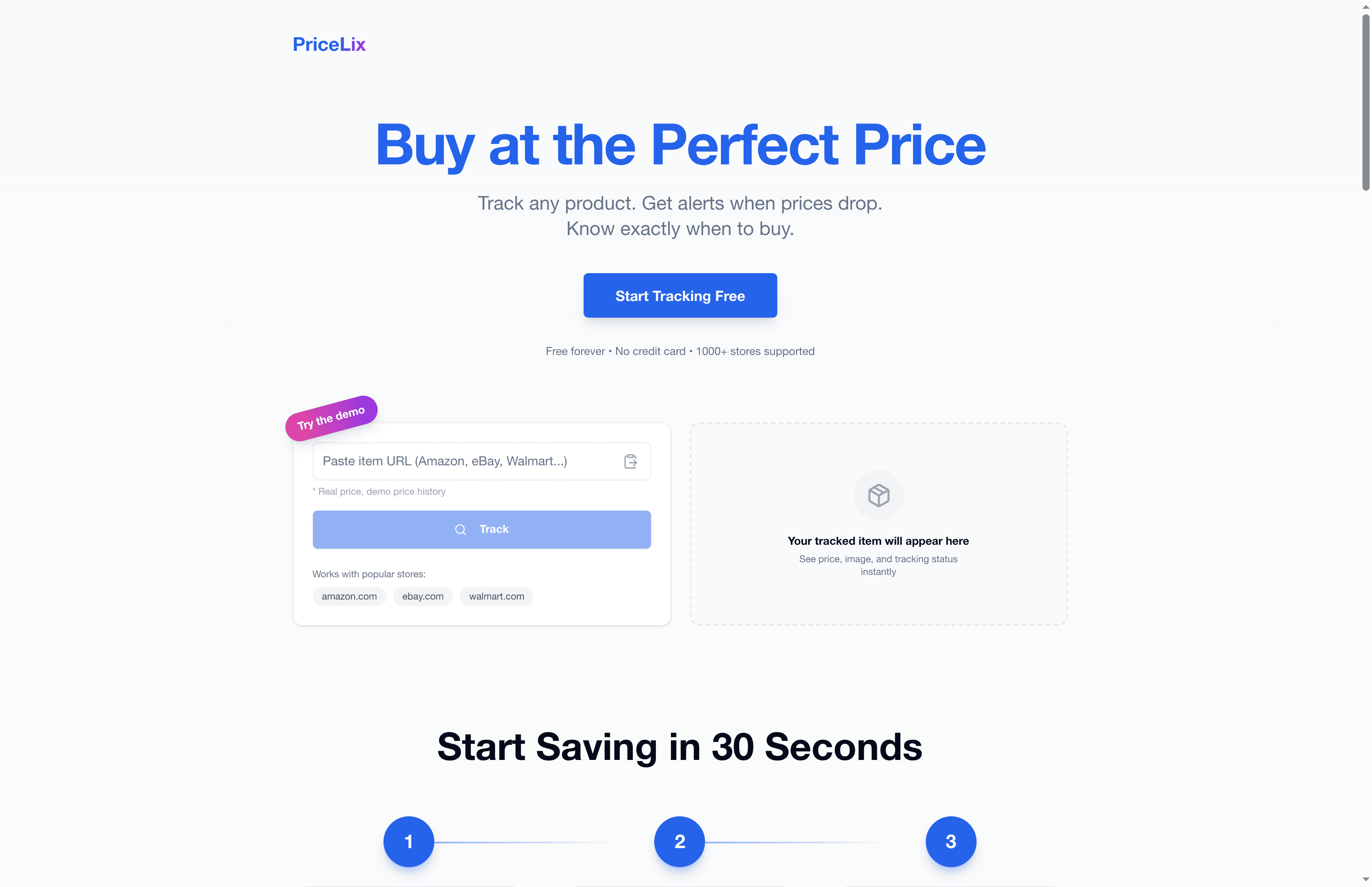
Ready to stop guessing and start saving today? Visit PriceLix to set up your personalized price alerts and access comprehensive price history charts in one place. Discover why hundreds of savvy shoppers trust PriceLix to maximize savings during sales and seasonal discounts. Experience firsthand how real-time price drop alerts and a centralized dashboard will change the way you shop online forever.
Frequently Asked Questions
What is automatic daily price monitoring?
Automatic daily price monitoring tracks product prices 24/7 without requiring any effort from you. Set it up to receive notifications about price changes, helping you make informed purchasing decisions based on real-time data.
How do real-time price drop alerts help me?
Real-time price drop alerts notify you immediately when the price of a tracked item falls. This allows you to act quickly to catch deals before they sell out, ensuring you never miss out on savings.
What can I learn from detailed price history charts?
Detailed price history charts provide insights into how a product’s price has changed over time. Analyzing these charts helps you spot buying patterns and determine the best times to buy, enhancing your purchasing strategy.
How does a centralized dashboard improve my shopping experience?
A centralized dashboard consolidates all your tracked items and displays their prices from various retailers in one place. This saves you time and simplifies decision-making by allowing you to compare prices easily and manage multiple items efficiently.
Why is wide store coverage important for price tracking?
Wide store coverage ensures you see prices from many retailers, not just a select few. This increases your chances of finding the best deals and discovering hidden savings that may be available at smaller or less-known retailers.
How can I track prices without using browser extensions?
You can track prices without browser extensions by using web-based tools that require no installation. Simply log in to the tracking platform from any device and start monitoring prices immediately.