
7 Smart Ways to Spot Fake Discounts and Shop Savvy
TL;DR:
- Fake discounts often rely on inflated reference prices and deceptive labels, making deals misleading.
- Cross-check prices across multiple retailers and review price history to verify genuine discounts.
- Be cautious of scam coupons, fake store websites, and always use credit cards for purchase protection.
7 smart ways to spot fake discounts and shop savvy
Fake discounts are bleeding shoppers dry, and most people have no idea it’s happening. A Consumers’ Checkbook study of 25 major retailers found products offered at artificial “discounts” over half the time, with 12 of those retailers running perpetual fake sales on more than 50% of their items every single week. That’s not a one-off trick by a shady website. That’s your favorite household-name retailers playing the system. The good news? Once you know what to look for, fake discounts are surprisingly easy to catch. This guide gives you seven practical, no-nonsense steps to verify every deal before you spend a single dollar.
Table of Contents
- Look up real price history
- Compare across multiple retailers
- Scrutinize ‘list price’ labels and disclosures
- Spot coupon and promo code scams
- Investigate the retailer and payment options
- Our take: the real cost of chasing fake deals
- Stop overpaying with PriceLix
- Frequently asked questions
Key Takeaways
| Point | Details |
|---|---|
| Use price history tools | Check historical prices to expose fake ‘was’ prices and real deals. |
| Cross-check retailers | Genuine discounts are rarely exclusive to one site, so compare widely. |
| Watch for fake promos | Be suspicious of huge coupon deals and verify codes directly with stores. |
| Prioritize safe payments | Always use credit cards for online purchases to protect yourself from scams. |
Look up real price history
Now that you know fake sales are everywhere, let’s start with the most reliable way to check if a deal is real: price history.
Price history is exactly what it sounds like. It’s a record of what a product actually sold for over time. When a retailer shows you a “was $120, now $79” tag, the price history tells you whether that item ever genuinely sold at $120 or whether that number was invented to make the “deal” look bigger than it is.
Here’s the uncomfortable truth: inflated reference prices are a standard retail tactic. The “original” price you see crossed out in red may have been the actual price for only a day or two before the “sale” started. Some products have never sold at the listed original price at all.
Using price history tools fixes this problem fast. Tools like CamelCamelCamel track Amazon product prices over months and years, giving you a visual chart of every price change. If you see that a $79 item was actually $75 for most of the past year, you know the “discount” is smoke and mirrors.
Here’s a quick comparison of popular price tracking tools:
| Tool | Stores covered | Alerts | Free to use |
|---|---|---|---|
| CamelCamelCamel | Amazon | Yes | Yes |
| PriceLix | 1,000+ stores | Yes | Yes |
| Honey | Multiple | Limited | Yes |
| Keepa | Amazon | Yes | Freemium |
For smarter shopping with price history, always look at at least 90 days of data. A chart that shows a sudden spike in “original” price right before a sale is a massive red flag. Real discounts dip below the long-term average price.
Red flags to watch for in price history:
- A price spike immediately before the “sale” began
- The “original” price appearing for only a few days
- Prices that bounce up and down constantly with no clear baseline
- The current sale price matching the price from six months ago
Pro Tip: Set up price drop alerts instead of impulse buying during sales events. Best price tracking strategies suggest waiting for the price to fall below the 90-day average before pulling the trigger.
Compare across multiple retailers
Even with price history, it’s smart to scan the market. Cross-checking different stores can reveal hidden fake discounts that a single tool might miss.
Here’s the logic. A retailer can show a “50% off” banner while still charging more than their competitors charge every day at full price. You’d never know unless you compared. Shopping bots and price comparison tools like CamelCamelCamel or Pricegrabber can tell you instantly whether a deal is genuinely low relative to competitors or just low relative to an inflated anchor price.

Let’s make this concrete. Say you’re eyeing a wireless speaker labeled “sale price: $89, was $149.” A quick cross-site check might show you that Walmart sells it every day for $84 and Best Buy has it at $91. Suddenly, the “50% off” deal looks a lot less impressive.
Here’s how to do a proper cross-retailer price check:
- Copy the exact product name and model number from the retailer’s listing.
- Paste it into Google Shopping to see prices from multiple stores simultaneously.
- Check two or three major retailers directly (Amazon, Walmart, Target) to verify current prices.
- Run the product through a price comparison tool for a broader market view.
- Note the lowest price you find and compare it to the “sale” price you’re being offered.
Here’s an example comparison for a fictional wireless speaker:
| Retailer | Regular price | Current “sale” price |
|---|---|---|
| Store A | $149 | $89 |
| Amazon | $87 | $87 |
| Walmart | $84 | $84 |
| Best Buy | $91 | $91 |
In this scenario, Store A’s sale price is actually higher than the everyday price at two other major retailers. That’s a fake deal, plain and simple.
For comparison best practices, always compare identical model numbers, not just product names. Retailers sometimes sell slightly different product versions under the same name to make direct price comparison harder.
Red flags when comparing across retailers:
- Only one retailer is running the “sale,” and all others have lower regular prices
- The product is exclusive to one store (making comparison impossible by design)
- The sale price is higher than competitors’ everyday prices
Learning how to compare deals online is one of the fastest ways to stop overpaying. It takes about two minutes and can save you real money every single time.
Scrutinize ‘list price’ labels and disclosures
Beyond cross-site pricing, deceptive list prices can make discounts look much better than they really are. Here’s how to read between the lines.
Retailers use several terms interchangeably to create the illusion of a bigger discount: “list price,” “regular price,” “was price,” and “MSRP” (manufacturer’s suggested retail price). These labels sound official, but they don’t always reflect what the product actually sold for.
Many sites, including Amazon and Best Buy, let you hover over a crossed-out price to see a definition of “list” or “regular” price. Sometimes the disclosure says something like “list price is the manufacturer’s suggested price, which may not reflect actual selling prices.” That’s a polite way of saying the number could be completely made up as a reference point.
The Federal Trade Commission has clear rules on this. FTC pricing guidelines state:
“A former price is not bona fide unless it was openly offered to the public for a reasonably substantial period of time in good faith, and the reduction from it is not fictitious.”
In plain English: retailers can only claim a discount from a price that was genuinely charged for a real period of time. Using an inflated fantasy number as a reference point is deceptive pricing under FTC rules.
Here are the red flag phrases and label types to watch for:
- “List price” with no disclosure of where it came from
- “Compare at” labels, common in outlet stores, which may refer to a price no one ever actually paid
- “Was” prices with no date showing when the item sold at that price
- “Manufacturer’s suggested price” used as the benchmark for a “discount,” since manufacturers often set MSRPs artificially high
- Crossed-out prices with no tooltip or disclosure when you hover
For monitoring sales strategies that actually work, always click on or hover over any crossed-out price. Read the fine print. If the disclosure says the reference price was set by the manufacturer rather than being the actual selling price, the discount percentage is likely misleading.
Spot coupon and promo code scams
Fake discounts aren’t limited to inflated prices. Scam coupons are everywhere too. Here’s how to protect yourself.
Coupon scams have exploded across social media platforms. You’ve probably seen them: posts that look like official retailer promotions offering 70% or 80% off everything in the store. They use real logos, professional graphics, and urgent language. They feel legitimate. They’re almost never legitimate.
Fake coupons often offer unrealistically high discounts, such as 80% off, or require you to provide personal information like your email, phone number, or home address just to “claim” the discount. Some go even further and ask for payment via gift cards to unlock a deal. Real retailers do not ask you to pay to access a coupon.
Here’s how to tell a fake coupon from a real one:
- Verify on the retailer’s official website first. If a 50% off code is circulating on Facebook, go directly to the retailer’s site and check their promotions page. Real deals will be listed there.
- Watch out for unrealistic percentages. Genuine coupons rarely exceed 20-30% off. An 80% off offer from a major brand is almost always a scam.
- Never enter coupons from pop-ups on third-party sites. These are common vehicles for phishing attacks.
- Check spotting price scams resources before engaging with any unfamiliar offer.
- Avoid coupons shared by random social media accounts, even if they tag the real brand.
For authentic discount code resources, stick to official brand pages, verified affiliate partners, and retailer newsletters.
Warning signs of a coupon scam:
- Requires personal information to claim a discount
- Demands payment via gift card or wire transfer
- The URL doesn’t match the official retailer’s domain
- Countdown timers creating artificial urgency
- No fine print, terms, or expiration date listed
Pro Tip: Only enter coupon codes directly in the retailer’s official checkout page. Never click “apply coupon” on a pop-up that appeared on a third-party deal site. If the code doesn’t work when you type it in manually on the real site, the coupon wasn’t real to begin with.
Investigate the retailer and payment options
Avoiding fake discounts also means avoiding fake stores or scam payment traps. Here’s your checklist before pressing buy.
Here’s something a lot of shoppers skip: vetting the store itself. You can do all the price history research in the world, but if the retailer is a scam site, the “discount” is just bait. Over 30% of EU retailers used fake discount tactics during peak sales events, and that number is growing globally.
Before you buy from any unfamiliar site, run through this simple three-step retailer check:
- Search the seller name plus the words “scam” or “review” in Google. Legitimate businesses have review trails. Scam sites usually have warning posts from burned customers. The FTC recommends this exact approach before buying from ads or unknown websites.
- Check the URL carefully. Scam sites often use domain names that are close to real brands but slightly off. Look for misspellings, extra hyphens, or unusual domain extensions like .shop or .net when the real site uses .com.
- Look for real contact information. A legit retailer has a physical address, a phone number, and a working customer service email. If the only contact is a generic form, walk away.
Payment method matters enormously here. Credit card payments give you purchase protection, meaning you can dispute the charge if the product never arrives or turns out to be fake. Debit cards, wire transfers, Zelle, and gift cards offer zero protection once the money leaves your account.
Retailer red flags to never ignore:
- Site running perpetual “going out of business” or “warehouse clearance” sales
- Prices that are drastically below every competitor with no explanation
- Only accepting payment by wire transfer, gift card, or cryptocurrency
- No clear return or refund policy listed on the site
- Spelling errors or poorly formatted pages suggesting the site was thrown together quickly
Always keep records of your purchase confirmations, receipts, and communications. If a dispute arises, documentation is your best asset.
Our take: the real cost of chasing fake deals
Here’s something most shopping guides won’t tell you. The greatest danger of fake discounts isn’t just financial. It’s psychological.
When you believe you scored a great deal, your brain releases a little hit of satisfaction. Retailers know this. They engineer fake discounts specifically to trigger that feeling and rush you through a purchase before you can think clearly. The artificial urgency, the big red price tag, the countdown timer, all of it is designed to short-circuit your judgment.
I’d argue that the biggest risk isn’t overpaying by $20 on a single item. It’s developing a habit of shopping based on “discount” signals rather than real value. Once you’re conditioned to chase the crossed-out price, you start buying things you didn’t even plan to buy just because the sale badge is there.
The solution isn’t to stop looking for deals. Real discounts absolutely exist, and they’re worth pursuing. The solution is to anchor every purchase decision in data rather than feelings. Price history doesn’t lie. Cross-retailer comparison doesn’t lie. The price chart is cold and boring and completely immune to retail theater.
Shoppers who use tools and price history consistently tend to spend less overall, not because they buy fewer things but because they stop impulse-buying fake deals. That’s the real payoff.
Stop overpaying with PriceLix
Knowing what to look for is half the battle. The other half is having tools that do the heavy lifting for you automatically.
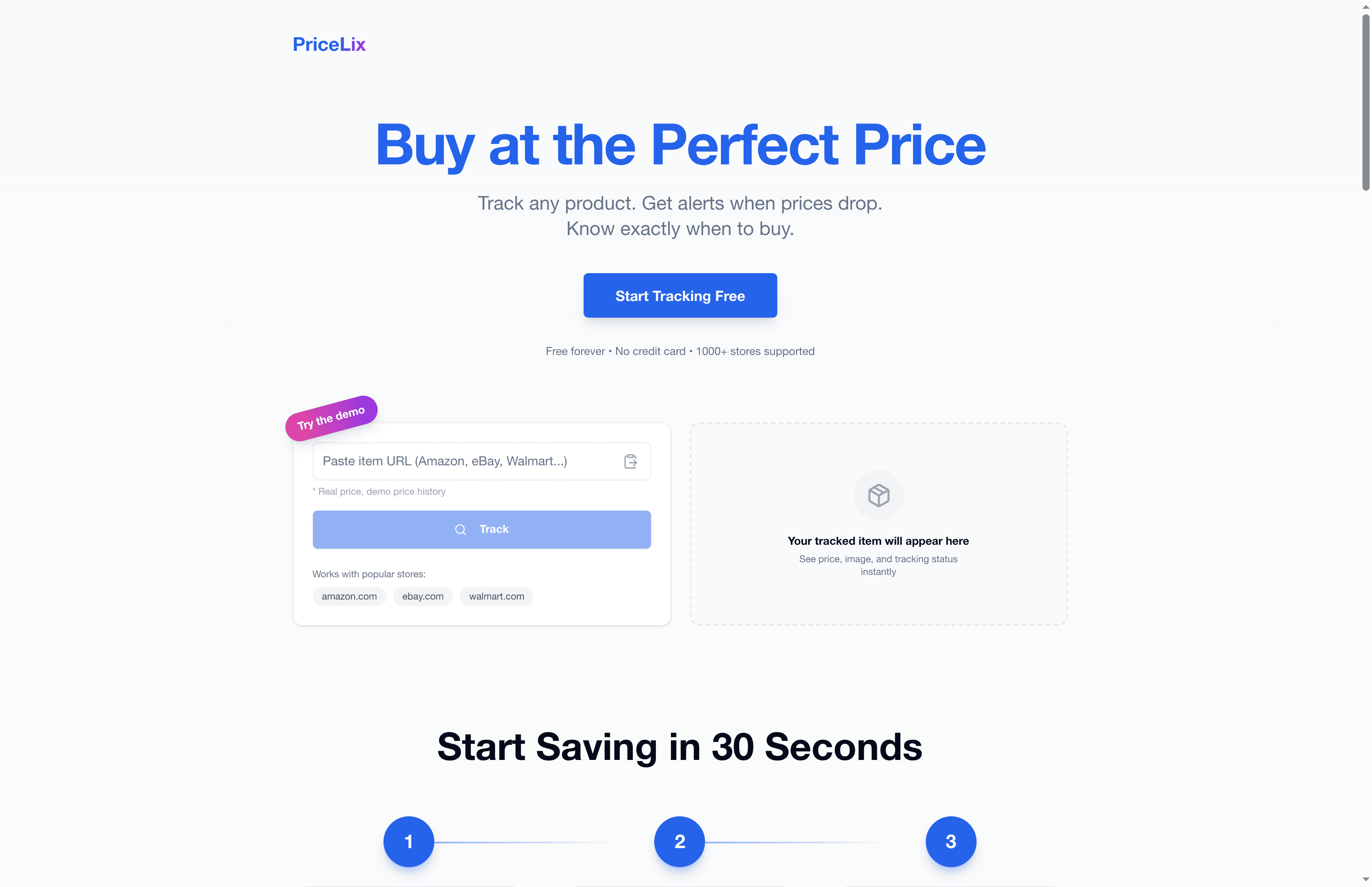
PriceLix was built for exactly this kind of shopping. It tracks prices across more than 1,000 retailers, shows you detailed price history charts so you can spot inflated reference prices instantly, and sends real-time alerts when a product genuinely drops below its historical average. No browser extensions. No complex setup. Just honest price data delivered to your dashboard every day. Whether you’re watching for a holiday sale, tracking a product launch, or just want to know if today’s deal is actually a deal, PriceLix gives you the clarity to shop with confidence and stop bleeding money on fake discounts.
Frequently asked questions
How can I check if a posted discount is real?
Always verify the product’s price history data using a trusted tracking tool. Genuine discounts consistently fall below the product’s long-term average selling price, not just below an inflated reference number.
What makes a ‘list price’ deceptive?
A list price is deceptive when it was rarely or never the actual selling price. FTC bona fide pricing rules require that any reference price must have been genuinely offered to the public for a reasonable period before a discount can be claimed.
What should I do if I find an 80% off coupon on social media?
Go directly to the retailer’s official website and check their promotions page before doing anything else. Fake coupons at 80% off are a common scam signal, and you should never enter personal information to claim any unsolicited coupon.
Why should I pay with a credit card for online deals?
Credit card purchase protection lets you dispute charges if a product doesn’t arrive or turns out to be counterfeit. Other payment methods like wire transfers or gift cards leave you with no recourse if something goes wrong.