
The Best Time to Buy Guide for Smart Shoppers
TL;DR:
- Retailers operate on predictable cycles like holidays and inventory refreshes, creating reliable discount periods.
- Understanding these patterns helps shoppers time their purchases, saving hundreds of dollars annually.
Most shoppers buy when they need something. Savvy shoppers buy when the price is right. That gap is where hundreds of dollars get left on the table every year. This best time to buy guide is built specifically for people who refuse to pay full price when they don’t have to. Retailers run on predictable cycles — seasonal clearances, inventory refreshes, and holiday promotions that repeat like clockwork. Once you know the pattern, you stop reacting and start planning. Let’s get into it.
Table of Contents
- Key takeaways
- The best time to buy guide starts with seasonal cycles
- Month-by-month breakdown of the best purchase times
- Category-specific timing and spotting fake deals
- Timing strategies for travel and airfare
- My honest take on timing your purchases
- Stop guessing. Let Price-lix track it for you
- FAQ
Key takeaways
| Point | Details |
|---|---|
| Retailers follow predictable cycles | Holiday and inventory schedules create reliable discount windows you can plan around each year. |
| Category timing matters more than generic sales | Memorial Day is great for mattresses but weak for laptops; match the sale to the product. |
| Price history is your best defense | Always verify a deal against the 90-day price history before assuming a sale is real. |
| Advance planning beats last-minute deals | Airfare and big-ticket items reward shoppers who book weeks or months ahead, not at the last minute. |
| Tools take the guesswork out | Automated price tracking removes the need to manually check dozens of pages every day. |
The best time to buy guide starts with seasonal cycles
You don’t need to memorize every sale date. You need to understand how the retail calendar works and why prices move when they do. That alone puts you ahead of most shoppers.
Retailers operate on two major forces: holiday-anchored promotions and inventory refresh cycles. The holiday side is what most people know. The inventory side is what separates good shoppers from great ones.
Here’s how the core cycle plays out across the year:
- January: Post-holiday clearance hits hard. TVs see steep markdowns right after the Consumer Electronics Show (CES), where new models are announced and old stock needs to move fast.
- February: President’s Day sales deliver 30 to 70% discounts on furniture, major appliances, and mattresses. These deals often rival or beat Black Friday for those specific categories.
- May/September: Kitchen appliance prices drop 20 to 35% around Memorial Day, Labor Day, and Black Friday as new model lines arrive. Retailers need floor space and they need it now.
- July: Amazon Prime Day has grown into a genuine shopping event for electronics and smart home devices, with discounts that rival November deals.
- November: Black Friday still dominates for consumer electronics, though the deals now spread across the entire month.
The other major force is off-season buying. Buying a winter coat in March or a grill in September feels counterintuitive. But off-season clearance on seasonal products is when retailers practically beg you to take inventory off their hands.
Pro Tip: Set a calendar reminder for the last week of each month during major seasonal transitions (February, May, September, November). That’s when clearance racks get fully stocked and prices hit their floor.

Month-by-month breakdown of the best purchase times
Here’s a practical calendar of when to buy what. This is your when to buy guide in table form.
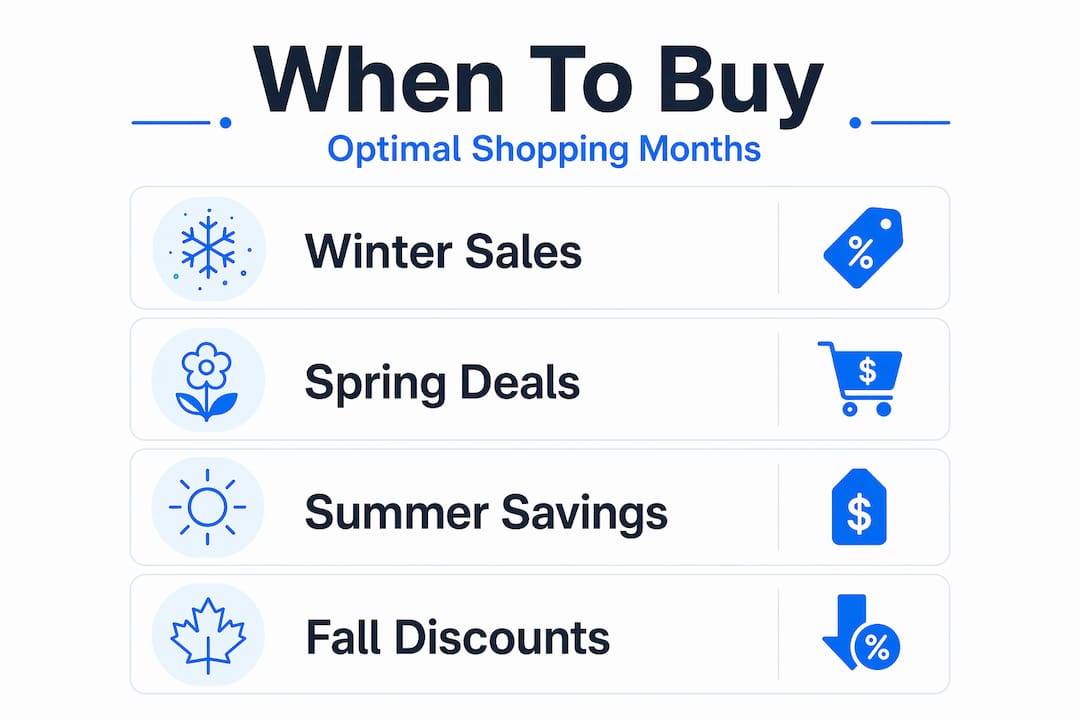
| Month(s) | Best categories to buy | Key sale event |
|---|---|---|
| January | TVs, small appliances, gym equipment | Post-holiday clearance, CES cycle |
| February | Mattresses, furniture, large appliances | President’s Day |
| March to April | Winter clothing, ski gear, vacuums | End-of-season clearance |
| May | Grills, patio furniture, mattresses, major appliances | Memorial Day |
| June to July | Laptops, smart home devices, air conditioners | Amazon Prime Day (July) |
| August | School supplies, laptops, backpacks | Back-to-school sales |
| September | Grills, lawn equipment, outdoor furniture | End-of-summer clearance |
| October | Halloween costumes, winter apparel (early), camping gear | Pre-holiday markdowns |
| November | TVs, laptops, gaming consoles, clothing | Black Friday, Cyber Monday |
| December | Toys, winter clothing, year-end tech | Holiday sales, year-end clearance |
A few patterns worth calling out specifically:
- January is criminally underrated for TV shopping. New models announced at CES in January push prior-year models into clearance. You can grab a 65-inch TV for hundreds less than what Black Friday shoppers paid two months earlier.
- August back-to-school season creates genuine laptop deals. Retailers know students and parents are buying. Competition drives prices down, especially on mid-range models.
- September is the single best month to buy grills and outdoor furniture. Seasonal discount strategies during this window can cut prices by 40 to 60%. Most shoppers won’t need a grill until next spring, but the price difference is real money.
The broader principle: the best purchase times are almost always when demand is low, not when everyone else is buying. Shopping the wave means paying peak prices.
Category-specific timing and spotting fake deals
Here’s where most general buying guides stop short. They tell you “buy electronics on Black Friday.” What they don’t tell you is that discounting aligns with inventory cycles and product launches more than with holidays alone. Knowing that difference saves real money.
How product cycles affect when to buy
- Consumer electronics: New products typically launch following CES in January and again in the fall. Buying the previous generation right after a new launch is often the best deal in tech. You get near-identical performance at a fraction of the price.
- Smartphones: Major releases from Apple and Samsung happen in September and August respectively. Wait 4 to 6 weeks post-launch and you’ll often find both the new model and the prior model discounted simultaneously.
- Appliances: New model introductions typically happen in spring. That means late winter (February) and late fall (November) offer the deepest cuts on outgoing models. Electronics and appliances tied to CES cycles move fast once a new lineup is announced.
- Mattresses and furniture: These are not driven by model cycles the same way. They respond to holiday promotions. Memorial Day, President’s Day, and Labor Day are the three strongest windows.
- Cars: End of month, end of quarter, and end of year. Dealers work on quotas. When they need to hit a number, your negotiating leverage goes up.
How to verify a deal is actually real
Not every sale is a sale. Some retailers inflate the “original” price weeks before a major event just to show a dramatic markdown. Here’s a quick process to protect yourself:
Check the price history. Verifying 90-day price history before buying confirms whether a discount is genuine or manufactured. Price tracking tools show you exactly what a product has sold for over time. If the “sale price” is actually what it sold for last Tuesday, you’re not saving anything.
Know which sales are genuinely strong for which categories. Memorial Day genuinely delivers on mattresses, large appliances, and outdoor gear. But it’s typically weak for laptops and TVs. For those, Prime Day and Black Friday produce deeper discounts. Don’t buy a laptop on Memorial Day because there’s a banner that says “Sale.” Check the numbers.
Pro Tip: Before buying anything over $100 during a sale event, pull up the price history chart. If the current sale price matches or exceeds the average price over the past 90 days, keep waiting. Real deals stand out clearly on a chart like that. It becomes gold.
You can read more about spotting fake discounts before you shop any major sale event.
Timing strategies for travel and airfare
Retail products are one thing. But airfare has its own completely separate logic, and most people get it wrong in the exact same way.
The myth is that waiting until the last minute scores cheap flights. Airlines know that trick and they price accordingly. Advance planning and flexible travel dates are what actually drive airfare savings. Not luck, not last-minute apps.
Here’s what the data actually shows:
- Domestic flights: The cheapest booking window averages 43 days before departure. A practical target is 1 to 2 months out for most domestic routes.
- International flights: Book 3 to 5 months ahead for international travel. Prices start climbing steeply inside the 60-day window.
- Day of travel: Flying Wednesday saves roughly 13% compared to Friday or Sunday travel. Weekend travel is peak demand, and airlines price it that way.
- Holiday travel windows: If you need to fly over Thanksgiving, Christmas, or spring break, the optimal buying periods shrink fast. Book holiday travel 3 to 4 months out, not weeks. The “wait and see” approach bleeds money here.
- Timing alerts: Set a price alert the moment you know your travel window. Prices fluctuate daily and catching a dip saves significantly more than trying to find the perfect moment to book manually.
The broader lesson applies across every purchase category in this guide: planned timing wins. Last-minute shopping, whether for a flight, a fridge, or a laptop, almost always costs more.
My honest take on timing your purchases
I’ve tracked retail pricing patterns long enough to say this with confidence: the biggest mistake shoppers make isn’t buying at the wrong time. It’s buying the right item at the wrong time because they couldn’t wait.
Patience is a purchasing strategy. Knowing that a refrigerator will be 25% cheaper in two months is only useful if you can actually hold off two months. That requires planning ahead, which most people skip.
The second mistake I see constantly is treating every holiday sale as equally valid for every product. The house always wins when you walk into a Memorial Day sale looking for a TV deal. The banners say “Sale.” The numbers don’t. Category knowledge is what separates a real 30% saving from a 5% markdown dressed up in red lettering.
What actually works, in my experience, is combining calendar knowledge with price history verification. Neither alone is enough. Knowing Memorial Day is a great time to buy a mattress is step one. Confirming the specific mattress you want is actually at its historical low is step two. Skip step two and you’re still gambling.
Tools that automate price tracking are worth every second you spend setting them up. Manually checking prices every few days is how people give up. Automation is how people actually save. Set it up once, get the alert, buy at the right moment.
— Serhii
Stop guessing. Let Price-lix track it for you
You now have the calendar knowledge and the category logic. The missing piece is execution. That’s where Price-lix comes in.
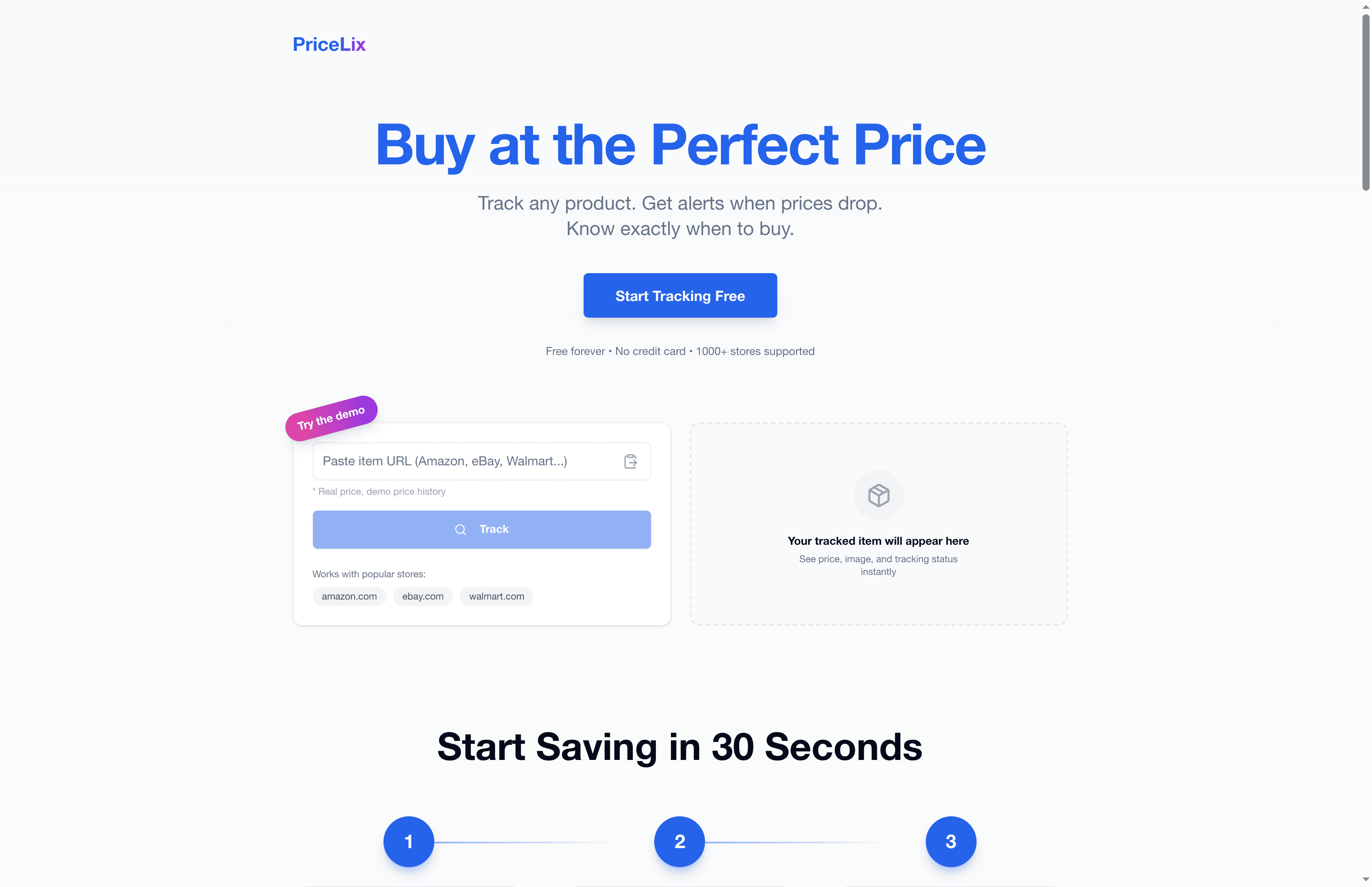
Price-lix tracks prices automatically across Amazon, eBay, Walmart, and over a thousand other stores. Add any item to your dashboard and Price-lix checks it daily, then sends you an alert the moment the price drops. No browser extensions, no manual checking. Just a clear price history chart and a notification when the timing is right. You can use it to monitor seasonal sales year-round or to confirm whether that “Black Friday deal” is actually the lowest price you’ll find. Ready to shop smarter? Visit Price-lix and start tracking your first item today.
FAQ
What is the best month to buy appliances?
May (Memorial Day), September (Labor Day), and November (Black Friday) offer the strongest discounts on major appliances, with price drops of 20 to 35% as retailers clear out old models.
Is Black Friday still the best time to buy electronics?
Black Friday and Amazon Prime Day in July consistently produce the deepest electronics discounts, particularly for laptops, TVs, and smart home devices, making them the top two buying windows for tech.
How far in advance should I book a flight to get the cheapest price?
For domestic flights, book roughly 1 to 2 months ahead. For international travel, 3 to 5 months before departure gets you the best rates. Last-minute deals are largely a myth.
How do I know if a sale price is actually a good deal?
Check the 90-day price history using a price tracking tool. If the current sale price is at or near the historical low, it’s a genuine deal. If the price has been lower recently, keep waiting.
When is the worst time to buy something?
Right after a product launches, right before a major holiday when demand spikes, and during peak season for any category. Those are the moments retailers have the least incentive to discount.