
Best time to buy: A step-by-step guide for shoppers
TL;DR:
- Retailers follow predictable cycles for discounts, allowing shoppers to time purchases for maximum savings.
- Using tools like price trackers and planning around key sales events helps avoid impulse buying and ensures smarter decisions.
You bought that laptop last Tuesday. Felt good about it. Then Friday rolls around and it’s $120 cheaper. That specific kind of frustration is something most shoppers know too well. The timing was off, and it cost real money. Here’s the thing: retailers don’t discount randomly. They follow predictable patterns, and once you understand those patterns, you stop being the person who pays full price three days before the sale. This guide walks you through the exact method experienced deal hunters use to buy at the right moment, every time.
Table of Contents
- Understand why timing matters for savings
- What you need: Tools and prerequisites
- Step-by-step: How to use the best time to buy method
- Fine-tune your approach: Adapting for different categories
- Avoiding mistakes and maximizing your savings
- The real secret: Flexibility and patience beat quick wins
- Take your savings further with smart shopping tools
- Frequently asked questions
Key Takeaways
| Point | Details |
|---|---|
| Timing saves money | Shopping during optimal sale windows and off-peak times can significantly cut costs. |
| Plan and track | Use price trackers and sale calendars to avoid missing real discounts. |
| Category matters | Different products have different sale patterns, so adapt your timing by category. |
| Beware of hype | Not every advertised discount is a real deal—verify before you buy. |
| Flexibility wins | Patience and readiness to act during the right window bring the greatest savings. |
Understand why timing matters for savings
To start saving more, let’s look at why timing consistently outperforms random deal-chasing.
Most shoppers treat buying as an event rather than a strategy. They see something they want, they check the price once, and they buy. That’s impulse buying, and it’s how you end up bleeding money without realizing it. The good news? Retailers operate on cycles. Once you learn those cycles, you’re not guessing anymore.
As Navy Federal’s buying guide points out, a practical “best time to buy” strategy involves targeting predictable seasonal clearance windows rather than hoping you stumble on a deal. That means planning around post-holiday sales, back-to-school periods, and events like Black Friday and Cyber Monday. Not waiting and hoping. Actually planning.
Timing also matters at the micro level. A Smartproxy study on price patterns found that online prices tend to be lower in the morning, specifically between 6 a.m. and noon, with Tuesday mornings standing out as the most affordable window on average. That’s not a coincidence. Retailers reset inventory and pricing early in the week, and low-traffic morning hours often see fewer dynamic price bumps.
Here’s a quick view of common sale windows and what they’re best for:
| Sale period | Best product categories | Typical discount range |
|---|---|---|
| Post-holiday clearance | Seasonal decor, clothing | 40% to 70% off |
| Black Friday / Cyber Monday | Electronics, appliances | 20% to 50% off |
| Back-to-school (July to August) | Laptops, school supplies | 10% to 35% off |
| End-of-season (winter, summer) | Apparel, outdoor gear | 30% to 60% off |
| Tuesday mornings (year-round) | Varies | 5% to 15% lower on average |
Key timing patterns to keep in mind:
- Prices often drop early in the week as retailers adjust for low weekend traffic
- Post-holiday periods produce the deepest discounts, but stock is limited
- Product launches push older models to clearance, creating hidden deals
- End-of-quarter periods see retailers clearing inventory for reporting reasons
Understanding deal hunting explained from a data perspective is the first step. Knowing when prices historically drop for your specific product category is the second. Both come from building a habit of checking price trends research before you buy, not after.
“Timing your purchases around clearance windows and known sales events is one of the most reliable strategies for saving money without sacrificing what you actually want.”
What you need: Tools and prerequisites
Knowing why timing matters, here’s what you’ll need to prepare before starting the best time to buy method.
You don’t need much to get started. But you do need the right mindset and a few basic tools. Winging it still won’t get you where you want to go. Here’s what to gather before you begin.
What you need to know before buying:
- The product name, model, or exact specs you’re targeting
- Its typical price range (not just the current listing price)
- Your personal deadline for the purchase
- Upcoming sales events that could affect the price
Tools that make this easier:
- A price tracking service that logs historical prices automatically
- Deal alert services that notify you when a product hits your target price
- A monthly sales calendar to anticipate known discount windows
- Spreadsheet or notes app to log your tracked products and price thresholds
As Wirecutter’s timing guidance explains, planning ahead is a core part of buying smart. Their “Knowing When to Buy” framework is built on understanding product cycles, not just waiting for random discounts. That applies to almost any product, not just TVs.
| Tool type | What it does | Good for |
|---|---|---|
| Price tracker | Logs historical price data | Knowing if a sale is actually a deal |
| Deal alert service | Sends notifications on price drops | Passive monitoring without daily checks |
| Sales calendar | Tracks upcoming events | Planning purchases months in advance |
| Price comparison site | Checks prices across multiple stores | Finding the lowest listed price right now |
Pro Tip: Set your target price threshold at 10% to 15% below the current price when setting alerts. That buffer protects you from minor dips and ensures you only act on genuine drops.
Combining bargain hunting strategies with a reliable seasonal sale tracking guide means you’re never starting from scratch each time you shop. You build a system, and the system does the heavy lifting.
Step-by-step: How to use the best time to buy method
With the essentials in place, let’s walk through each step of the best time to buy method, breaking it down for easy implementation.

This is the core of what separates a deal hunter from a casual shopper. Follow these steps for any product you’re targeting, and you’ll consistently land better prices.
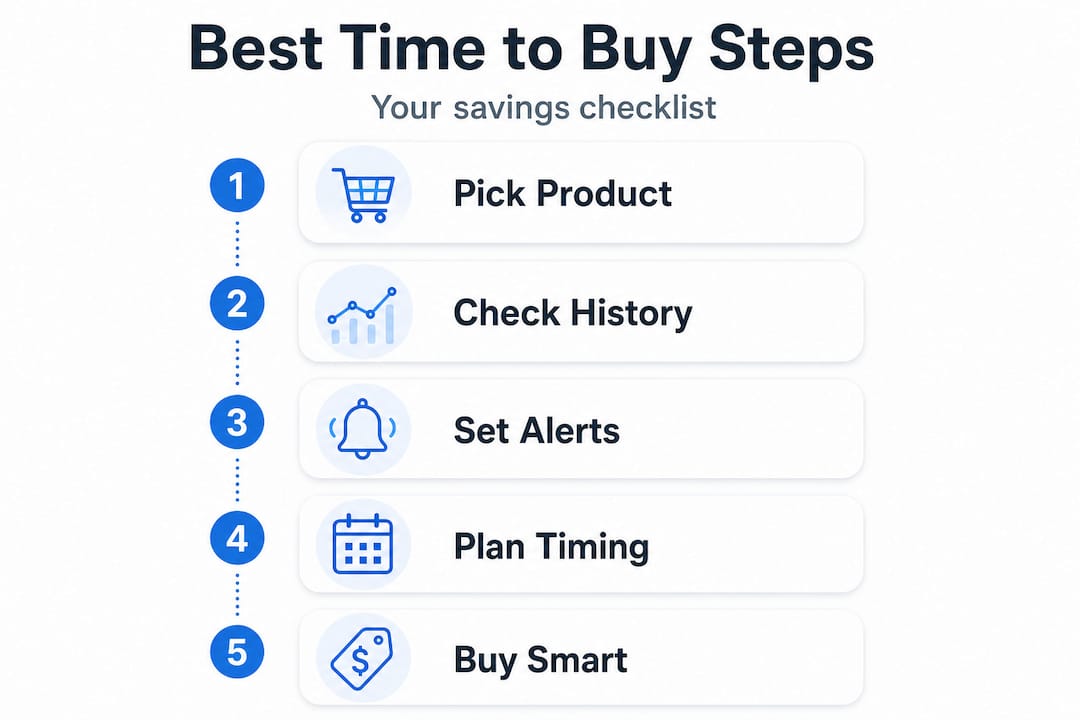
Step 1: Identify your product and its sale cycle
Start with the exact item, not a vague category. “Headphones” is too broad. “Over-ear noise-canceling headphones under $200” gives you something to track. Then research its typical sale cycle. When did it last drop in price? Is a new model coming out soon? Older model releases are almost always followed by discounts.
Step 2: Check price history and set alerts
This is where price history becomes gold. If a product is listed at $149 and its 12-month low is $99, you know $149 isn’t a deal. Pull up the price history chart, identify the lowest points, and set an alert at or just above that low. You’ll get notified the moment it approaches that level, without checking daily. Wirecutter’s timing guidance consistently emphasizes using this kind of historical knowledge as the foundation for timing decisions.
Step 3: Plan around upcoming windows
Map out the next 60 to 90 days. Are there any major holidays? Is it getting close to back-to-school season? Is a new product generation expected? These windows aren’t guarantees, but they’re significantly higher-probability moments for price drops. Cross-reference your alert with these calendar events so you’re ready to act.
Step 4: Verify before you buy
When your alert fires, don’t buy immediately. First, confirm the price drop is real by checking the price history. Some retailers inflate prices ahead of “sales” to make discounts look larger than they are. If the price history shows the item was at $120 three months ago and is now “on sale” from $160 to $130, that’s not a real deal. That’s manufactured urgency.
Step 5: Buy during the optimal window or wait for the next one
If the verified price meets your threshold and a sale window aligns, buy. If you’re not sure, ask yourself: Is there a better window in the next 30 days? If yes, wait. If not, and the price is close to the historical low, pull the trigger.
According to the Smartproxy study, Tuesday mornings are cheapest on average for online purchases, making them ideal for executing planned buys.
Here’s a timing reference for the most reliable windows:
| Timing window | Why it works | Best action |
|---|---|---|
| Tuesday morning (6 a.m. to noon) | Retailers adjust prices early in the week | Execute planned purchases |
| Day after major holidays | Deep clearance begins | Shop for seasonal items fast |
| 30 days after new model launch | Previous model prices drop | Buy prior-gen tech |
| End-of-season clearance | Inventory needs to move | Stock up for next year |
Pro Tip: Combine deal alerts with a price tracker so you catch both the seasonal dip and the daily timing window at once. That double-confirmation method is how you predict the best time to buy with real confidence instead of guessing.
Fine-tune your approach: Adapting for different categories
Now that you have the basic method, it’s essential to fine-tune your approach based on what you’re buying and your specific timeline.
Not all products behave the same. Electronics follow a different rhythm than clothing. Home goods have completely different seasonal cycles. Adjusting for your category is what turns a general strategy into a personalized one.
Electronics:
New models drop in spring and fall cycles. Best timing for electronics often clusters around May and holiday-adjacent weekends. Buying the previous generation right after a new release is one of the most reliable ways to score a significant discount on quality gear. Also, end-of-year sales events are historically productive for tech.
Apparel:
Clothing follows a simple rule: buy out of season. Winter coats hit their lowest prices in January and February. Summer gear gets cleared in August and September. If you can plan 6 months ahead, you can buy quality clothing at a fraction of the regular price.
Home goods and appliances:
Holiday weekends like Memorial Day, Labor Day, and Presidents Day are well-known discount windows for large appliances. Mattresses, refrigerators, and furniture routinely see 20% to 40% off during these events.
What if you can’t wait?
Sometimes urgency overrides strategy. Your washer breaks, your laptop dies, you need it now. As the practical guidance at Cheapest.Discount’s buy vs. wait guide notes, “buy now vs. wait” always hinges on urgent need and timing. Waiting with no clear discount catalyst ahead is just guesswork. When urgency is real, buy the best available deal right now and move on.
Use seasonal discount strategies and track factors affecting online prices to build a personalized calendar that reflects what you actually buy, not just generic advice.
Avoiding mistakes and maximizing your savings
Even practiced deal hunters make mistakes. Here’s how to avoid common errors and make the most from your timing strategy.
Common mistakes and how to fix them:
- Assuming one big sale is always the lowest price. Black Friday gets all the hype, but it’s not always the best deal. Post-holiday clearance and back-to-school events often beat it for specific categories.
- Skipping price history verification. A “50% off” badge means nothing without context. Always check where the price has actually been over the past 6 to 12 months before getting excited.
- Letting FOMO drive the purchase. “Only 3 left in stock” is one of the oldest tricks in retail. If it’s a popular item, it’ll come back. If it won’t, check your urgency honestly.
- Setting and forgetting alerts. Alerts are useful but not perfect. Revisit your tracked items every few weeks to make sure the threshold still makes sense given current pricing trends.
- Ignoring restocking risk. Some items do sell out and don’t return at the same price. As Wirecutter’s monthly predictions guide explains, treat timing as windows matching your timeline, accounting for shipping delays and restock cycles.
Pro Tip: Set a firm budget before you start tracking a product. Write it down. When emotions kick in during a “sale,” that number is your anchor. It’s the difference between a smart purchase and a temptation buy you’ll regret.
Learn to spot fake discounts before they catch you off guard, and build a routine for monitoring discounts over time rather than relying on single moments of luck.
The real secret: Flexibility and patience beat quick wins
Here’s a candid take from years of observing how real savings habits pay off.
Most shoppers wildly overestimate the power of a single sale event. They circle Black Friday on the calendar like it’s a guaranteed treasure hunt. But the data doesn’t support that. Some of the best deals we’ve ever seen happened on a random Tuesday in March, not during a hyped holiday weekend.
The shoppers who consistently win aren’t the ones who stay up at midnight clicking refresh. They’re the ones who set their target, build their alert, and go live their lives. Flexibility is what makes that possible. When you’re emotionally detached from the purchase, you make better decisions. When you’re counting down to a single event with your credit card in hand, you’re more likely to buy something that doesn’t actually meet your threshold just because the moment feels right.
There’s also a real cost to obsessing over timing. Spending hours chasing a deal that saves $15 isn’t a win if it took three hours of your time and energy. Efficient deal hunting means using deal hunting lessons to build a system that runs in the background, not one that takes over your day.
The uncomfortable truth? Not every wait pays off. Some products don’t get cheaper. Some categories stay flat for months. Patience is valuable, but it’s not magical. The method works best when you combine historical data with your personal timeline and make a rational call. Flexibility means being willing to act when the moment is right, not just when the calendar says so.
Take your savings further with smart shopping tools
Ready to maximize every dollar you spend? Here’s how to move from theory to real-world results.
You’ve learned the method. Now it’s about execution without the manual grind. That’s exactly what PriceLix is built for. It automatically tracks prices across Amazon, eBay, Walmart, and over a thousand other stores, giving you real-time alerts when prices hit your target. No browser extensions, no daily checking, no guesswork.

With PriceLix, you get full price history charts so you can instantly verify whether a sale is real, a consolidated dashboard for every product you’re watching, and automated daily checks that do the monitoring while you focus on everything else. It’s the tool that turns this method from a good idea into an actual habit. Explore PriceLix and start using data-driven price tracking to buy smarter on every purchase.
Frequently asked questions
What is the best time of day to buy online for the lowest prices?
Morning hours between 6 a.m. and noon on Tuesdays tend to offer the lowest prices, based on a Smartproxy study on shopping timing. Tuesday mornings are the cheapest window on average for online purchases.
Are clearance periods after major holidays really the best time to buy?
Yes, especially for seasonal categories. Post-holiday clearance windows routinely produce the deepest discounts of the year, often beating headline events like Black Friday for specific product types.
How do I know if I should buy now or wait for a better deal?
Weigh your urgency against upcoming sale windows. If you can wait and a clear discount cycle is coming, patience usually wins. But as Cheapest.Discount’s timing guide notes, waiting with no clear discount catalyst ahead turns patience into guesswork.
What tools can help me predict the best time to buy?
Price trackers, deal alert services, and monthly sales calendars are the core tools. Together, they let you monitor price history, get notified on drops, and plan around known sale events without daily manual effort.